©2023
Joanna Tochman. Selected works from 2018—2023
Joanna Tochman, 2018—2022
Design Gabriela Basta

Something feels not quite right. Lines intersect to create uncanny perspectives; unearthly plants emerge from cracks in the soil; the light looks strangled. In Kraków-based artist Joanna Tochman’s paintings, condensed landscapes and illogically replicating pools challenge one’s sense of space and the fuzzy realm between reality and fiction.
Kate Mothes, Jacuzzi Error. Exploring the logic of space with Joanna Tochman, “Dovetail Magazine” 2022
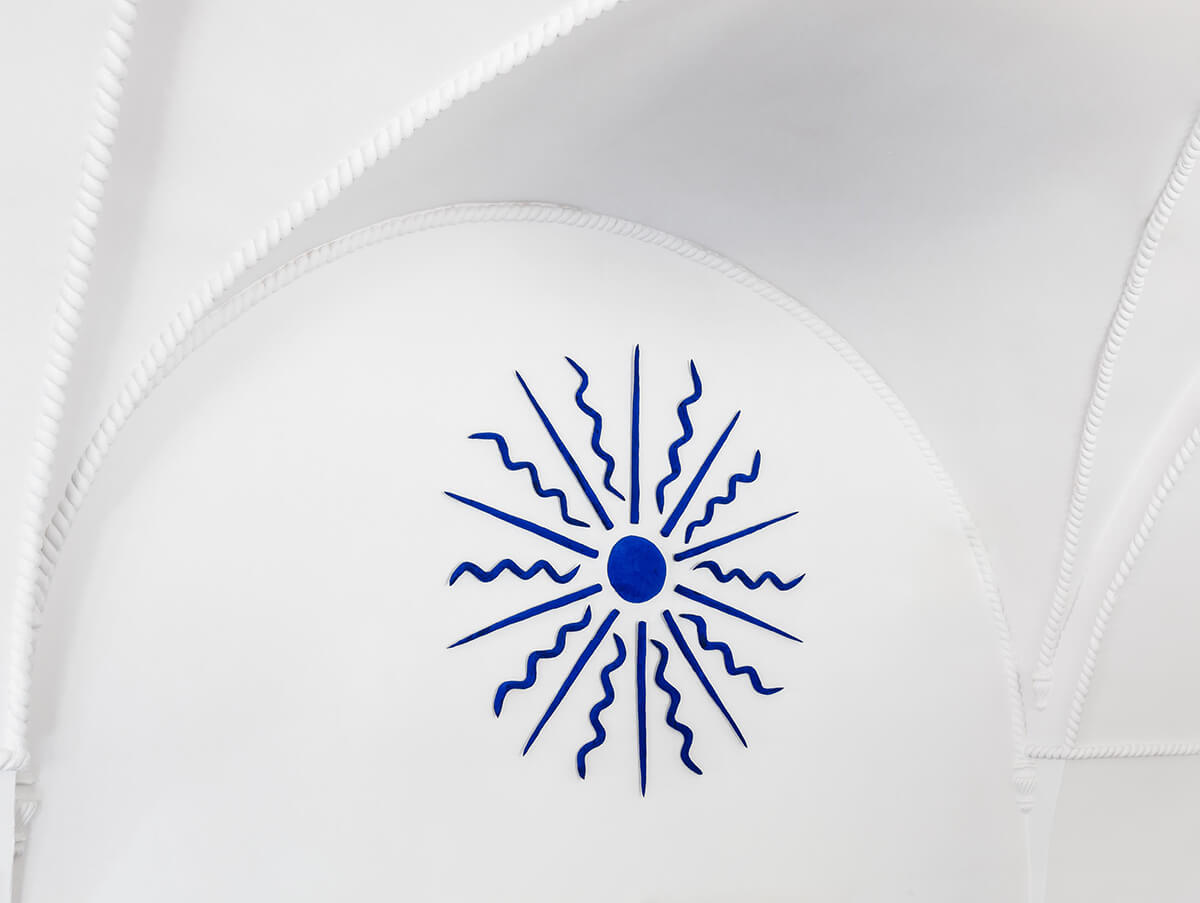
Sunspot, 150 x 150 x 20 cm, plaster, dry pigment, 2023
Presented on exhibition Orbium coelestium, De revolutionibus ideas, Cracow, 2023.
Currently on display in Larisch Palace, Cracow.
Sunspot is inspired by Georges Bataille’s story The blue of noon and the crucial role of sun motif in author’s works.
When I was a boy, I loved the sun; I used to shut my eyes and let it shine redly through my lids . The sun was fantastic – it evoked dreams of explosion. Was there anything more sunlike than red blood running over cobblestones, as though light could shatter and kill? […] My eyes were no longer lost among the stars that were shining above me actually, but in the blue of the noon sky.
I shut them so as to lose myself in that bright blueness. From it, fat black insects spouted forth in buzzing swarms[…]
I opened my eyes. The stars were still covering my head, but I was maddened with sunlight. I felt like laughing […] So I had laughed, and it was no longer merely the gloomy boy with his cruel pen who was walking through the night hugging the walls: I had laughed the same laugh as a child, convinced that one day, since such a lucky insolence was sustaining me, it was I who was bound to turn the world upside down – turn the world, quite ineluctably, upside down.
Georges Bataille, The blue of noon, 1935
Most of the artist’s paintings are large, filling our field of vision like the backlit screen of a computer animation. Recently, her “Computer Game Landscapes” series introduces the viewer to vivid, otherworldly vistas reminiscent of early digital games. In using a traditional medium like oil paint, she confronts the “technical” way that landscape is presented in early computer games, especially the blocky, pixelated artwork made as a result of the low-resolution television and computer screens at the time.
Translating a digital space into an analog medium, she instills each work with the presence of the artist’s hand despite the absence of human presence amongst the scenery. Some compositions appear unsettlingly glitchy where elements have duplicated or gotten stuck, as if time has been paused—until the play button is pressed again. The indefinitely multiplying landscape alludes to the way a player proceeds through a level, each scene regenerating indefinitely until some predetermined goal has been reached. In Tochman’s paintings, the goal has been removed altogether, so one feels uncomfortably at loose ends, stranded.
Kate Mothes, Jacuzzi Error. Exploring the logic of space with Joanna Tochman, “Dovetail Magazine” 2022
Volcanic desert, installation, plaster, cardboard, dry pigment, dry ice, 2020
Presented on exhibition Open your mouth, give me a wink, F.A.I.T., Cracow, 2020.
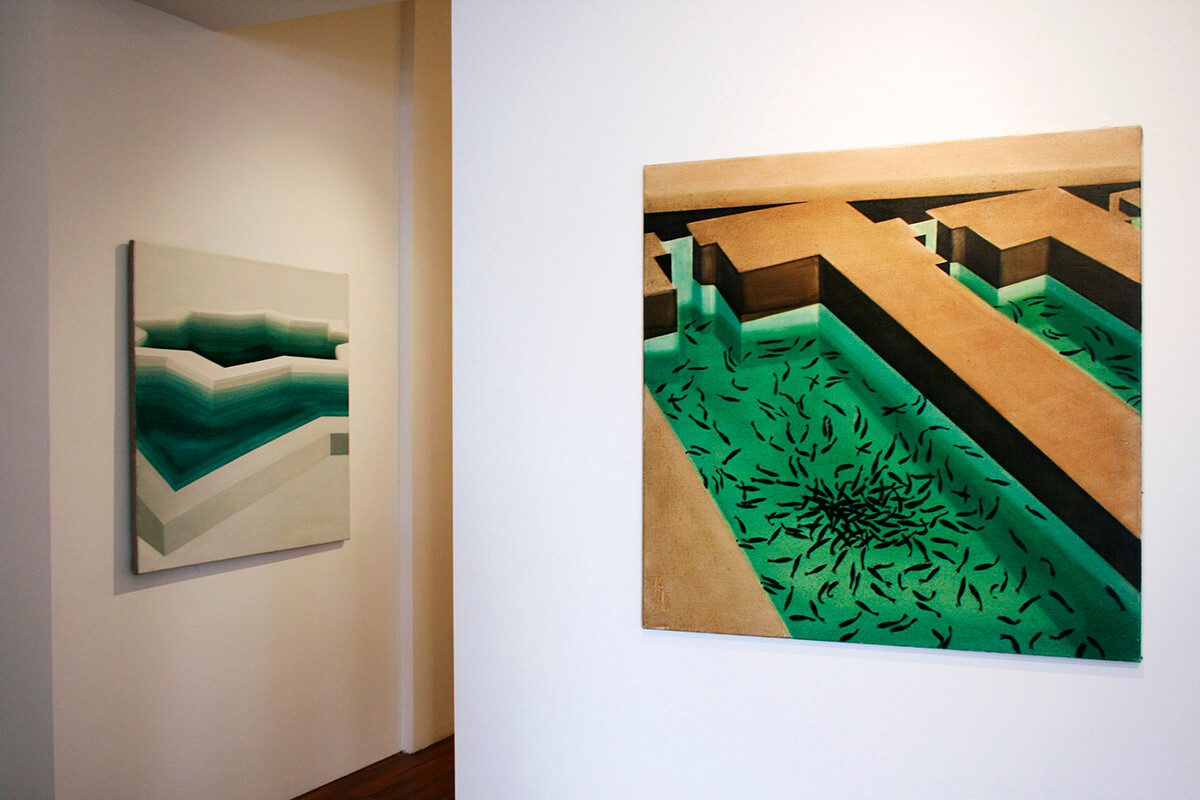
Slightly earlier paintings from the series “Swimming Pools” and “Multiplication” focus on architectural details, pulling the viewer into mysterious indoor worlds where the boundaries of the rooms seem to fall off the edges. Often seemingly void of life, like holding tanks or empty baths, stepped pools and reservoirs appear both enormous yet isolated, highlighted by an unknown light source and reaching to unnerving depths.
Kate Mothes, Jacuzzi Error. Exploring the logic of space with Joanna Tochman, “Dovetail Magazine” 2022
Cranach’s pool, analog large format and medium format photography, 2018
A series inspired by artist’s disturbing obsession with Lucas Cranach’s painting Fountain of Youth.
The rules of the game go as follows: one must copy Cranach’s pool, move it to another location, trace it on the ground using pins and strings, while maintaining the exact proportions of the pool depicted in the painting. The task is not easy—what emerges in the field looks completely different than on the camera’s matrix, it turns out that perspective is a lie, and one has to contort oneself terribly to ensure the outlined shape has the appropriate proportions. In reality, it stretches across the entire meadow and more than a pool resembles a lying pillar.
As if viewed in mirrors that face each other or in the rippling reflection of water, Tochman’s disorienting compositions explore movement and time through spaces that exist between the natural and artificial. Sometimes referencing specific places, like a swimming pool in Szeged, Hungary, the specifics of place are blurred at the periphery. The longer we spend in them, the more dreamlike they become.
Kate Mothes, Jacuzzi Error. Exploring the logic of space with Joanna Tochman, “Dovetail Magazine” 2022
Often seemingly void of life, like holding tanks or empty baths, stepped pools and reservoirs appear both enormous yet isolated, highlighted by an unknown light source and reaching to unnerving depths. When we do encounter living beings, like in the series “Fights”, it is in the form of trout, the collective term for which is a “hover,” when their congregations take a violent turn. What are they doing there? Are they going mad within the confines of their basins?
Kate Mothes, Jacuzzi Error. Exploring the logic of space with Joanna Tochman, “Dovetail Magazine” 2022